|
AI Dev Revolution: The Great Resuffle, Microsoft's Phi-3.5, and Perplexity Updates |
| |
|
Welcome to the latest neural network-optimized edition of "AI for Developers," where we're fine-tuning your knowledge base with the freshest AI insights straight from the cutting edge!
This week, we're diving headfirst into the future of AI, unearthing innovations that are set to redefine the landscape of technology as we know it.
So, power up your development environment, max out those GPUs, and get ready to integrate the latest AI innovation into your projects! |
| |
|
The Great Reshuffle: How AI is Redefining Dev Teams |
| |
When Our Code Starts Coding: The AI Feedback Loop
Picture this: You're a software developer, sitting at your desk, crafting intricate lines of code that will shape the digital world. Now, imagine that very code you've written is about to revolutionize your own profession. Sounds like science fiction? Well, welcome to the reality of AI in software development.
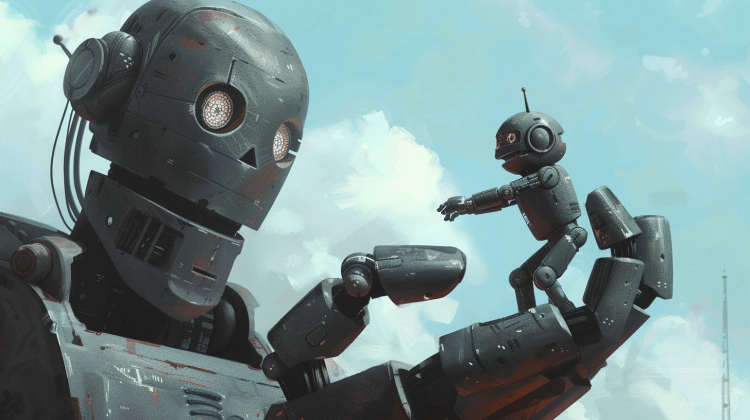
Remember that scene in countless action movies where the hero throws a boomerang, only to have it unexpectedly return and knock them off their feet? That's eerily similar to what's happening in our field right now. We, the software developers, have created AI, and now it's coming back to disrupt our entire workflow. It's as if we've launched a missile that's changing course mid-flight, heading straight back to us.
From Writing Code to Managing AI: The New Dev Skillset
Now, I can almost hear some of you saying, "AI will never fully replace humans!" And you know what? I agree. But here's the kicker – it doesn't need to replace us entirely to change our lives forever. (Unless, of course, we suddenly find ourselves living out the plot of "Dune" – in which case, all bets are off!)
So, let's move past the naive argument that AI will simply take over jobs. The reality is far more nuanced and, dare I say, exciting. The question isn't whether AI will replace us but how it will reshape our teams and redefine our roles.
AI Agents: Your 24/7 Coding Companions
Close your eyes for a moment and try to envision the software development team of the future. Got it? Now, let me share what I see:
- The Rise of the AI Agents: Imagine AI-powered agents that work tirelessly, handling tasks that once required specialized roles like SRE, backend engineering, frontend development, and even security. These agents won't work in isolation but will take on increasingly complex tasks, working around the clock.
- From Coding to Orchestrating: As developers, our role will shift from writing every line of code to becoming conductors of a grand AI-powered symphony. We'll guide these AI agents, review their work, and make critical decisions that bridge technology and business needs.
- The Human Touch: Some roles will remain firmly in human hands—at least for the foreseeable future. Product management and engineering leadership will continue to rely on human expertise for nuanced communication and complex decision-making.
The Three Phases of AI Integration in Dev Teams
As we stand on the brink of this transformation, I see three distinct stages unfolding:
- The Cautious First Steps: AI agents start by executing basic automation tasks. Think of them as super-smart deployment scripts, suggesting next steps but waiting for human approval.
- The Collaborative Middle Ground: In this stage, AI agents gain situational awareness, producing code on the fly to fix problems. However, humans still play a crucial role in reviewing and confirming these actions.
- The Autonomous Future: Here's where things get really interesting. Agents become capable of writing code, executing it, and maintaining full situational awareness before and after. They adopt the OODA loop (Observe, Orient, Decide, Act), constantly iterating and improving.
Data-Rich Domains: Where AI Will Strike First
If you're wondering which areas of software development will feel the AI tremors first follow the data. Areas rich in data are prime candidates for AI disruption. Operations and Site Reliability Engineering (SRE) work are likely to be at the forefront of this change.
But here's the fascinating part – as AI takes over these operational aspects, it gains valuable feedback on everything it does. This creates a snowball effect, allowing AI to expand its influence into feature development, testing, documentation, and beyond.
Human Insight in an AI-Driven Development World
Now, before we get carried away with visions of AI-powered utopias, let's consider the obstacles we face:
- The Human Factor: As developers (and let's face it, as humans), we're naturally skeptical about handing over control to machines. Remember the autopilot feature I built for a startup's autoscaling product? Almost all our customers balked at the idea of trusting the machine completely.
- Integration Challenges: Implementing AI automation isn't as simple as flipping a switch. It requires significant effort to integrate with existing tools and workflows, which can make the perceived ROI seem less attractive.
Legal and Ethical Challenges of AI-Assisted Coding
If an AI agent makes a decision that impacts people's health or lives, who's accountable? To what extent? These are questions we'll need to grapple with as a society.
Bridging Business and Tech: The Evolving Role of Tech Leads
As we stand at this crossroads of human ingenuity and artificial intelligence, I can't help but wonder: What do you see when you look into the future of software development?
- Which roles do you think will evolve or disappear?
- When do you anticipate these changes taking place?
- Is there a future where software teams as we know them cease to exist entirely?
I'm eager to hear your thoughts, predictions, and even your wildest speculations. After all, we're not just observers in this AI revolution – we're active participants, shaping the future of our profession with every line of code we write and every decision we make. So, let's continue this conversation.
Share your vision of the future in the comments below, and let's explore this brave new world of AI-augmented software development together.
Remember, the future isn't set in stone – it's a canvas waiting for us to paint upon it. What masterpiece will we create? |
| |
|
How Cloude 3.5 Artifacts Redefines Collaborative Coding |
| |
|
Anthropic’s new feature, Artifacts, allows developers to create websites, code snippets, documents, and more with simple prompts using the Claude 3.5 Sonnet model. Built-in just three months by a small, distributed team, Artifacts is designed to make coding and collaborative work with AI faster and more intuitive. The feature was prototyped using Streamlit and later refined with a Node.js backend and a frontend stack, including React, Next.js, and Tailwind CSS. Artifacts integrate AI directly into the development workflow, significantly reducing the time needed for tasks like web application development. The team leveraged Claude's capabilities extensively during the development, using it to quickly iterate and refine the feature. The result is a tool that not only accelerates the coding process but also transforms how developers interact with AI, making it more immediate, tangible, and collaborative.
How Artifacts Could Be a Game Changer for Developers
Artifacts can potentially revolutionize software development, igniting a wave of excitement, especially for web developers. By simplifying the process of creating web applications and other digital artifacts, developers can move from idea to execution faster than ever before, inspiring a new level of creativity and innovation in the industry.
Examples:
- Rapid Prototyping: With just a prompt, a web developer could generate a fully functional single-page application (SPA) in React or HTML. This dramatically cuts down the time spent setting up and configuring basic components, allowing developers to focus on more complex and creative tasks.
- Collaborative Coding: Teams can now use Artifacts to build and refine web applications in real-time, fostering a sense of unity and efficiency in the development process. For instance, a developer could start with a basic layout and then evolve the design and functionality through iterative prompts, seamlessly integrating feedback from team members. This collaborative approach not only speeds up the development process but also ensures that the final product is a collective effort.
- Automated Code Generation: Artifacts can automate the generation of repetitive code, such as form validations or standard CRUD operations, freeing developers from boilerplate tasks and enabling them to concentrate on higher-level logic and user experience design.
For web developers, Artifacts represents a significant leap in how they can approach coding, turning what used to be tedious, manual tasks into quick, AI-assisted processes that enhance productivity and creativity. |
| |
|
New OSS LLMs, Fine-Tuning, and AI-Powered Tools for Developers |
| |
|
Nvidia’s Llama-3.1-Minitron 4B: Small Model, Big Impact
Nvidia's Llama-3.1-Minitron 4B is a new small language model (SLM) about efficiency. Built with pruning and distillation, it performs like a heavyweight while keeping training costs low. It is available now on Hugging Face under the Nvidia Open Model License. (Link)
Microsoft’s Phi-3.5: The New SLM Champion
Microsoft just dropped Phi-3.5, a small model that outperforms the competition. With versions ranging from 3.8B to 41.9B parameters, this model sets new benchmarks in reasoning and math. It's available for free download and ready to run on local tools like Ollama. (Link)
AI21’s Jamba Models: Long-Context Powerhouses
AI21’s Jamba 1.5 Mini and Large models are here to revolutionize long-context tasks. With a true context window of 256K tokens and a hybrid architecture, these models are built for speed and efficiency. The Jamba 1.5 Large boasts 398B parameters, making it a force to be reckoned with. (Link)
Dracarys Models: Code Like a Dragon
Abacus.ai introduces Dracarys, a new family of LLMs tailored for coding. Designed to enhance existing open-source models, Dracarys is optimized for coding tasks, delivering significant performance boosts on LiveBench.(Link)
OpenAI Unveils Fine-Tuning for GPT-4o
OpenAI just rolled out a fine-tuning feature for GPT-4o, giving developers the power to tailor the model’s responses using their own datasets. Expect better performance and accuracy in your AI-driven apps. (Link)
Perplexity’s Code Interpreter Gets a Boost
Perplexity's latest update supercharges its code interpreter. Now, it can install libraries and display charts, making it even more versatile for developers. (Link)
Zed Editor Integrates Anthropic AI
Zed, the blazing-fast text editor built in Rust, has added new AI features powered by Anthropic’s Claude. This brings enhanced AI-driven capabilities to an already impressive tool. (Link) |
| |
|
Featured Pull Requests from Our Blog |
| |
Unmasking AI's Secret Weapon: Image and PDF Preprocessing for RAG
Think AI can't read your PDFs? Think again! Document Layout Detection and Vision Transformers are revolutionizing how AIs digest unstructured data, and it's about to change the game for developers everywhere. Dive into our full series and learn how to harness these powers to supercharge your AI applications. Your documents will never look the same again! (Link)
ChatGPT for DevOps: Your AI Intern That Never Sleeps
Discover how ChatGPT can transform your workflow from "it works on my machine" to "it works everywhere, always.". Learn to harness AI power to refine CI/CD pipelines, debug issues, and even explain complex concepts to your non-tech colleagues (without the eye-rolling). ChatGPT can make you the DevOps hero you always knew you could be discover how here. (Link)
AI Accelerators vs GPUs: The Silicon Showdown You Never Knew You Needed
There's a new chip war in town, and it's all about who can make AI hallucinate faster. In one corner, we have the jack-of-all-trades GPUs. The overachieving cousins skipped general computing in the other AI accelerators and went straight for the AI gold. Grab your popcorn, devs – this showdown is just starting, and may the best chip win! (Link)
That’s it for this week's issue. Remember to subscribe so next week's update auto-deploys to your inbox, keeping you in sync with the latest AI frameworks and breakthroughs. In the ever-evolving world of AI, we're all just trying to stay one step ahead of the machines.
Keep your code clean and your models trained, and maybe start practicing your "Welcome, Robot Overlords" speech... just in case. |
| |
|