Zuck’s Llama 3.1, OpenAI’s innovations, and DeepMind’s feats. Unpack the latest AI news now!
Zuck’s Llama 3.1, OpenAI’s innovations, and DeepMind’s feats.

Hey there, code wranglers and AI tamers!

Welcome to the latest edition of "AI for Developers,” where we can pull the hottest AI news and apply the latest updates to your neural networks!


Buckle up because we’re about to download a whirlwind of AI advancements. Grab your favorite caffeinated beverage, fire up your IDE, and dive into this AI extravaganza; we’ve got more to unpack than a Docker image on launch day! ;)

Zuck's Glow Up and Llama's Leap: Meta's Open-Source AI Revolution

While you've been busy fine-tuning your models, Mark Zuckerberg's been fine-tuning his image. Once the archetypal “billionaire in a hoodie,” the Meta mogul is now strutting around in shearling jackets, sporting gold chains, and looking less like "I'll harvest your data" and more like "I'll open-source your future."

But forget the beard—real or Photoshopped—and whether Zuckerberg now resembles Coldplay frontman Chris Martin because Zuck's dropping something far more exciting than a new profile pic. 

Enter Llama 3.1: Meta's 405-billion-parameter titan, a Hulk-size beast about to crash the open-source AI party harder than a Silicon Valley hackathon.

Strap in, devs. We’re about to dive deep into this woolly wonder and see if Llama 3.1 can spit game as impressively as Zuck’s newfound style. Is this the dawn of a new, more transparent Meta, or just another day in the AI arms race? 


Let's find out! :)

Llama 3.1's Impressive Stats

405 Billion Parameters of Pure Power

Llama has a staggering number of parameters. There are so many that if each were a paperback book, Llama 3.1's library would stretch from Earth to the Moon approximately 20 times over! We know this because we checked with several AI models, and they verified the calculation before asking us if Llama would get 20 times the overdue book fees.

Multilingual Mastery

Llama 3.1 isn't just fluent in Silicon Valley-ese. It also has a grip on English, German, French, Italian, Portuguese, Hindi, Spanish, and Thai. It's like the UN of AI, minus the crippling bureaucracy.

128k Token Context Window

Remember when 2k tokens seemed impressive? Llama 3.1 laughs in the face of such peasantry with a 128k token context window that matches GPT-4’s best. This beast can keep more context in its head than your average politician making campaign promises.

Open Weights, Open Possibilities

While not fully open-source (Meta's keeping its training data close to its chest), Llama 3.1's weights are out in the wild. This means devs can fine-tune and adapt it faster than you can say, "Hulk smash!"

Benchmarks: Llama's Game is Strong

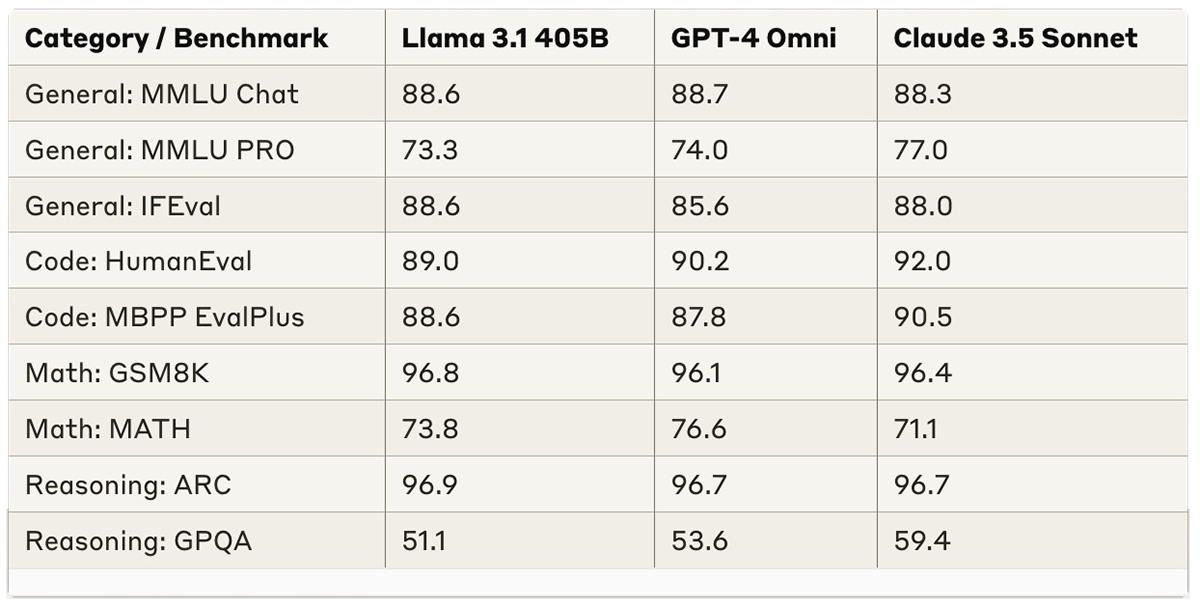
Llama 3.1 isn't just talk. It's walking the walk (or, should we say, trotting the trot?) on all the key benchmarks. 

Here’s how it stacks up against other frontier models:

These impressive results demonstrate that not only has open-source ‘arrived,’ like a sheepskin coat-wearing rockstar crashing an after-hours party, but it can compete with the best, offering greater customizability and cost-effectiveness to boot. Indeed, Llama 3.1’s costs per token are some of the lowest in the industry, making it the AI equivalent of finding designer gear at thrift store prices!

The Open-Source Advantage

Llama’s advantages don’t end with cost savings. Closed-source models can be difficult to obtain and tightly controlled, while Llama 3.1 is the AI equivalent of a versatile multitool for tech enthusiasts. 

This open approach means:

  1. Faster innovation (because more brains are better than one, even if that one brain belongs to a tech billionaire)
  2. Better security (more eyes on the code means fewer places for bugs to hide)
  3. Customization galore (want an AI that speaks exclusively in haiku? Llama’s got you covered)

The Future is Llama-shaped (and Zuck-approved)

It's incredibly exciting to have an open-source frontier-level model that is this powerful. Llama 3.1 is leading the way, creating an entirely new AI ecosystem for developers. 

It's clear that the future of AI isn't just about raw power—it's about open-source accessibility and giving everyone access to this world-changing tech.

Zuckerberg's transformation from social media villain to open-source AI champion is as unexpected as it is intriguing—it’s like watching Darth Vader return to the light side. Whether it's a genuine change of heart or a masterclass in PR, one thing's for sure: by unleashing Llama 3.1 on the world, Zuck is not just changing his image—he's potentially revolutionizing the entire AI landscape.

(Link)

OpenAI's Latest AI Lineup: Affordable Power and Endless Betas

OpenAI has just unveiled GPT-4o Mini, a budget-friendly powerhouse that’s up to 60% cheaper than the GPT-3.5 Turbo and considerably more capable. The model supports text and vision in the API and boasts a 128k context, just like its larger sibling. Part of a growing trend to provide developers with cost-effective solutions combining intelligence and affordability, GPT-4o Mini is available here.


Next up, SearchGPT  OpenAI’s answer to Google’s SGE, which itself was a response to the efforts of the plucky startup Perplexity.ai. OpenAI promises to give you “fast and timely answers with clear and relevant sources.” Translation: it’ll regurgitate Wikipedia faster than your know-it-all cousin at a family dinner. But don’t get too excited – it’s in “temporary prototype mode” (limited alpha testing), which is OpenAI code for “we have no idea when we’ll release this fully.”


Lastly, ChatGPT is finally getting a voice upgrade. So, if you’re among the few early testers chosen from the vast hoards coughing up $20 a month, you might soon hear your AI respond with emotions and non-verbal cues. Otherwise, you’ll watch them test it on YouTube while fruitlessly checking your ChatGPT settings. Don’t hold your breath, though. At this rate, OpenAI should just rename itself to ‘AlphaAI.’ Because with everything they have in alpha testing, they might as well be trying to corner the market on perpetual prototypes.


AI Newsflash: Brains, Billions, and Bargains

DeepMind's Math Prodigy: Google's AI snagged silver at the International Math Olympiad, answering 4 out of 6 questions. Mathematicians cling to the two it flunked as proof of their relevance for another year. Next challenge: splitting the bar tab after happy hour. (Link)

Mistral's Budget Brainiac: with 123 billion parameters of math-crunching code-spewing capability. Still, the kid brother to GPT-4, but offering AI smarts at bargain basement prices, Mistral's got your back. (Link)

Amazon's Chip Dreams: Adding to its “we sell absolutely everything” portfolio, Amazon is now playing AI chip designer, hoping to ditch Nvidia's pricey silicon for its homegrown AI brains. Meanwhile, Nvidia's Jensen Huang sits astride his  $2 trillion AI mountain, promising chips so fast they'll time travel. Bezos probably wonders if he can power AIs with leftover Prime Day boxes. The real winner? Electricity companies. (Link)

Tech's AI Cash Bonfire: Tech giants are burning AI cash faster than a Bitcoin miner in a heatwave. Zuckerberg's spending billions on Nvidia GPUs, while Alphabet has already torched  $12 billion and Microsoft’s year over year at $13.64 billion. Meanwhile, OpenAI's burning through cash faster than a Kardashian at a Balenciaga boutique seems to have dropped $5 billion down the back of its digital sofa. It looks like the future of AI will be less "artificial intelligence" and more "astronomical investment"!

Featured Pull Requests from Our Blog

RAG: The AI Swiss Army Knife You Didn't Know You Needed

Ever wonder why tech giants are falling head over heels for Retrieval Augmented Generation (RAG)? Spoiler alert: it’s the secret sauce behind those eerily accurate, context-aware AI responses. Think RAG might just be your golden ticket to creating the next big AI app? You’re probably right. And if you're curious about which RAG tools are poised to take over the AI world in 2024, we’ve got you covered. Dive into the full article here.

Introduction to LLMOps: Mastering the Fundamentals

Think you're ready to master the mysterious art of LLMOps? This course can help. Blending theory and hands-on practice, you'll deploy and optimize large language models like a seasoned pro. Jump in here.

GraphRAG: Microsoft's New Data Retrieval Microservice

Microsoft's latest tool, GraphRAG, is turning the data world on its head. But what makes it so special? This LLM-powered tool builds rich knowledge graphs from text docs, potentially revolutionizing how we query and analyze data. NASA is already on board and using it to supercharge its Open Science Data Repository. But how exactly does GraphRAG work its magic? Dive into our full article to uncover the secrets of GraphRAG. (Link)


So there you have it, folks – another wild sprint through the AI landscape. Remember, in the world of AI, we're all just trying to stay one step ahead of the machines. 

Keep your code clean and your models trained. Until next time, may your bugs be shallow and your AI assistants benevolent!

The AI for Developers Team